


Knowing how to cook a Christmas turkey mostly comes down to four things: thawing it fully, roasting at a steady moderate heat, checking the temperature rather than the clock, and letting it rest before carving. Get those right and even a first-timer can put a juicy, golden bird on the table. This guide walks you through each step for the free-range turkeys and capons we sell at Organic Village, with a roasting time table by weight, a simple way to make gravy from the pan juices, and what to do if you've chosen our ready-to-heat stuffed turkey instead. The timings are ranges, not promises: every oven runs a little differently, and a small condo oven can be hotter or cooler than its dial says. Use the table to plan your afternoon, and a meat thermometer to decide when the bird is done.
How long to thaw a frozen turkey
Our raw turkeys and capons are delivered frozen, and thawing is the step to plan first. The safe method is in the fridge: allow about 24 hours for every 2 kg. A 6 kg turkey therefore needs around three days; a 3 kg capon about a day and a half. Check the weight on the label as soon as it arrives and count backwards from the day you'll cook.
Keep the bird in its packaging, breast side up, on a tray or in a roasting tin to catch any liquid, on the lowest shelf so nothing drips onto other food. It's thawed when the legs move freely and there are no ice crystals inside the cavity. Once thawed, cook it within 1–2 days.
- Never thaw at room temperature or in a warm sink; in Bangkok the outside warms into the danger zone long before the centre thaws.
- Short on time? Submerge the wrapped bird in cold water, changing the water every 30 minutes, and allow roughly 30 minutes per 500 g. Cook it straight away.
- Don't refreeze a raw bird once it has fully thawed.
Preparing the turkey for the oven
Take the bird out of the fridge 30–45 minutes before roasting, no longer in a warm kitchen. Remove the neck and giblets from the cavity (keep the neck for gravy), and pat the skin dry with kitchen paper. Dry skin browns and crisps; wet skin steams.
Season generously with salt and pepper inside and out, then rub soft butter or oil over the breast and legs. A halved onion, lemon, garlic and a few herbs in the cavity add aroma without slowing the cooking much. If you want stuffing, cook most of it in a separate dish: a tightly packed cavity takes much longer to reach a safe temperature. If you do stuff the bird, fill it loosely and check the stuffing reaches 74 °C too.
Set the turkey on a rack or a bed of sliced onions and carrots in the roasting tin, and add a glass of water or stock to the tin so the juices don't burn.
Turkey roasting time per kg
At 170–180 °C (fan ovens at the lower end), plan on roughly 35–45 minutes per kg for an unstuffed bird. The table gives practical ranges by weight. Start checking the temperature 30 minutes before the shortest time, especially in a small oven where the bird sits close to the heating element.
Cover the breast loosely with foil for the first two-thirds of the cooking, then remove it so the skin can brown. Baste with the pan juices every 45 minutes or so, closing the oven door quickly each time. If the tin runs dry, add a little more water.
Roasting a capon instead? The method is identical, just shorter: a capon has a higher proportion of fat under the skin, so it bastes itself and browns well. Our raw capons (6–8 and 8–10 pax) and the fresh raw capon usually fall in the first row of the table, but always go by the weight on the label and the thermometer reading.
| Bird weight (oven-ready) | Fridge thawing time | Roasting time, unstuffed (170–180 °C) | If stuffed, add |
|---|---|---|---|
| 2.5–3.5 kg (capon) | 1.5–2 days | 1 h 45 – 2 h 15 | 15–20 min |
| 3.5–4.5 kg | 2–2.5 days | 2 h – 2 h 45 | 20–30 min |
| 4.5–5.5 kg | 2.5–3 days | 2 h 30 – 3 h 15 | 20–30 min |
| 5.5–6.5 kg | 3–3.5 days | 3 h – 3 h 45 | 30 min |
| 6.5–8 kg | 3.5–4 days | 3 h 30 – 4 h 30 | 30 min |
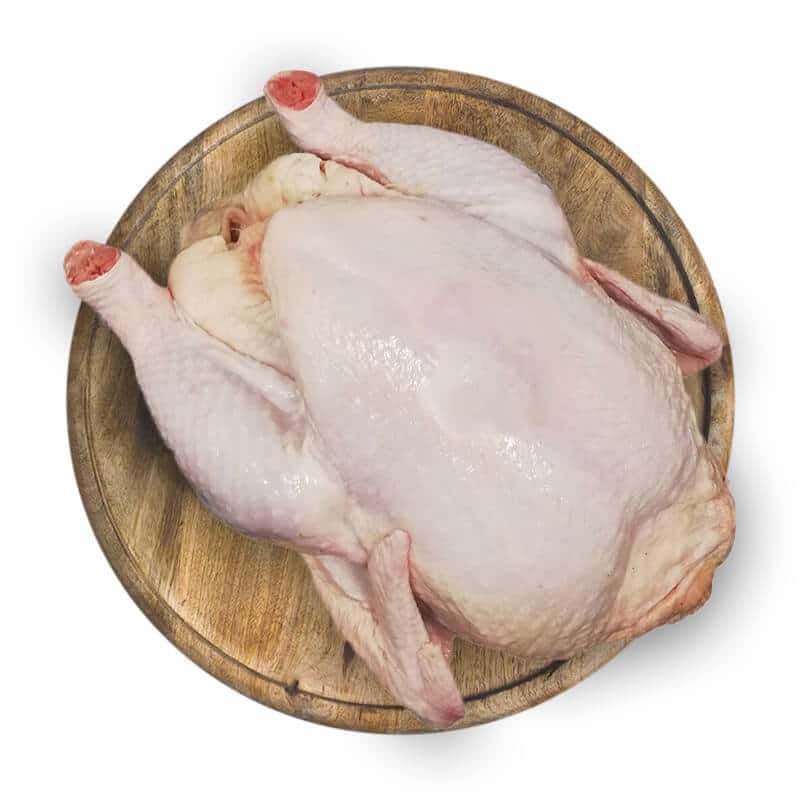
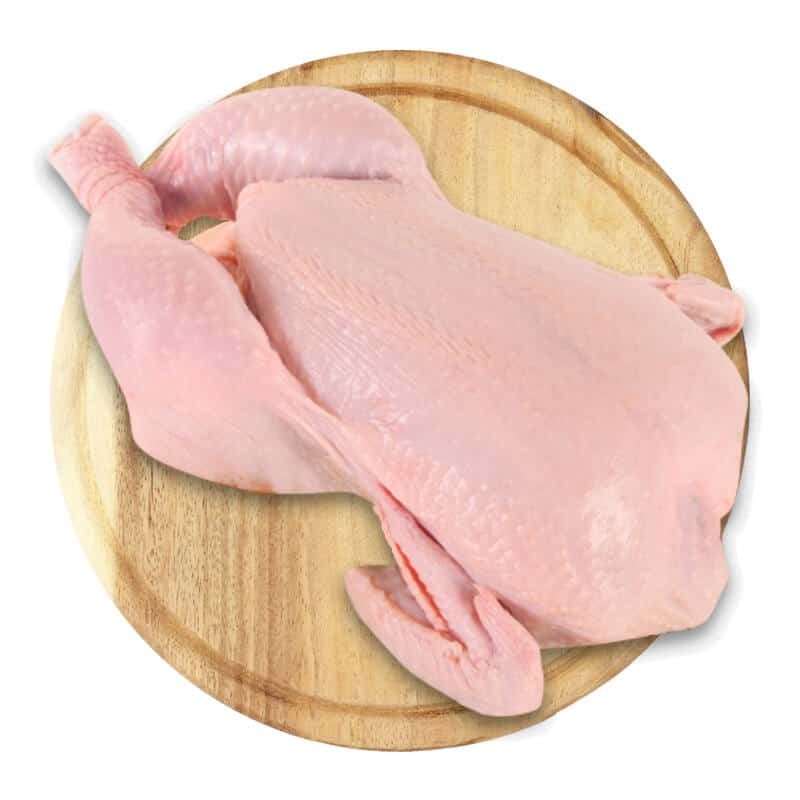
Checking doneness: 74 °C in the thigh
A meat thermometer is the single most useful tool for Christmas dinner. Insert it into the thickest part of the thigh, close to but not touching the bone. Poultry is safely cooked at 74 °C (165 °F). Check the thickest part of the breast as well; it usually gets there first.
Without a thermometer, pierce the thigh at its thickest point: the juices should run clear, not pink, and the leg should feel loose when you wiggle it. These signs are less reliable than a reading, so a thermometer is worth the small investment if you roast once a year.
Resting, carving and making gravy
Lift the turkey onto a board, cover it loosely with foil and rest it for 30–45 minutes (20–30 minutes for a capon). The temperature keeps rising slightly, the juices settle back into the meat, and you free the oven for potatoes and sides. A large bird stays hot under foil for this long.
To carve, cut the legs away at the joint, then separate drumsticks and thighs. Slice down along one side of the breastbone and lift each breast off whole, then slice it across the grain into thick pieces. It's easier and neater than slicing directly on the frame.
For gravy, pour the pan juices into a jug and spoon off the fat. Put the tin on the stove, stir in a spoonful of flour with a little of the fat, then whisk in the juices and some stock. Simmer for 5–10 minutes, scraping up the browned bits, season and strain. Add the juices that collect on the carving board at the end.
How to reheat our ready-to-heat stuffed turkey
The pre-cooked stuffed turkey with foie gras and truffles is fully cooked, so the goal is to warm it through gently without drying it out. Thaw it in the fridge first, allowing the same 24 hours per 2 kg; reheating from frozen leaves a cold centre.
Then follow the instructions on the pack, which give the exact temperature and time for that product. As a general principle: a moderate oven, the bird covered with foil, a little liquid in the tin, and patience. Remove the foil for the last part if you want to crisp the skin, and check that the centre of the stuffing is piping hot before serving. Reheat only once.
The same approach applies to our pre-cooked capons, ballotines and poularde: thaw in the fridge, reheat gently and covered, follow the pack.
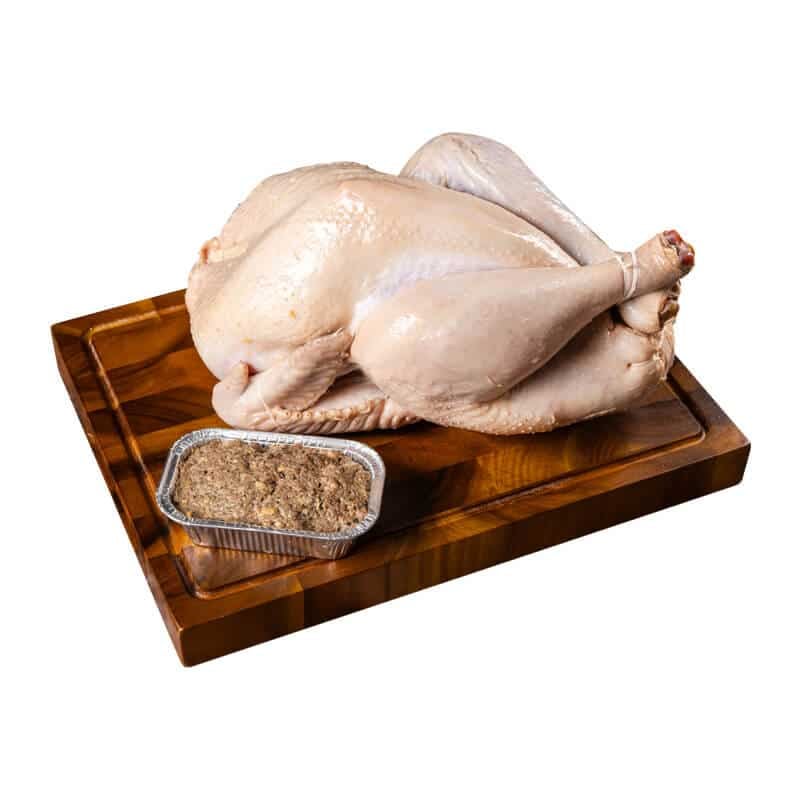
Pre cooked frozen stuffed Whole turkey
Foie Gras Truffles · 10 pax · Free range · Non Gmo · Natural Fed
Questions & answers
How long does it take to thaw a frozen turkey in the fridge?
Allow about 24 hours for every 2 kg. A 4 kg bird needs about two days, a 6 kg bird around three, and an 8 kg bird roughly four. Keep it in its packaging on a tray on the bottom shelf, and cook it within 1–2 days of it fully thawing.
What temperature should I roast a turkey at?
A steady 170–180 °C works well for most home ovens, at the lower end if yours is a fan oven. Higher temperatures dry the breast before the thighs are cooked. Some cooks start at 200 °C for 20 minutes to brown the skin, then lower the heat for the rest of the roast.
How do I know when the turkey is done?
Use a meat thermometer in the thickest part of the thigh, without touching the bone: it should read 74 °C (165 °F). The juices should run clear and the leg should move loosely. Times in any table are only a guide; the temperature is what matters.
Should I cover the turkey with foil while roasting?
Cover the breast loosely for the first two-thirds of the cooking time so it doesn't dry out or brown too fast, then uncover it to crisp the skin. After roasting, tent it with foil again while it rests for 30–45 minutes before carving.
Can I cook a turkey from frozen?
It's possible, but it takes around 50% longer and the outside tends to overcook before the inside is safe, so we don't recommend it for a Christmas centrepiece. Thaw the bird in the fridge instead, and if you're short on time use the cold-water method.